
MCB vs MCCB vs ACB vs RCCB: Difference & When to Use
Published 3 min readManaged by Skylights Energy for vendorstocks.com
The short answer
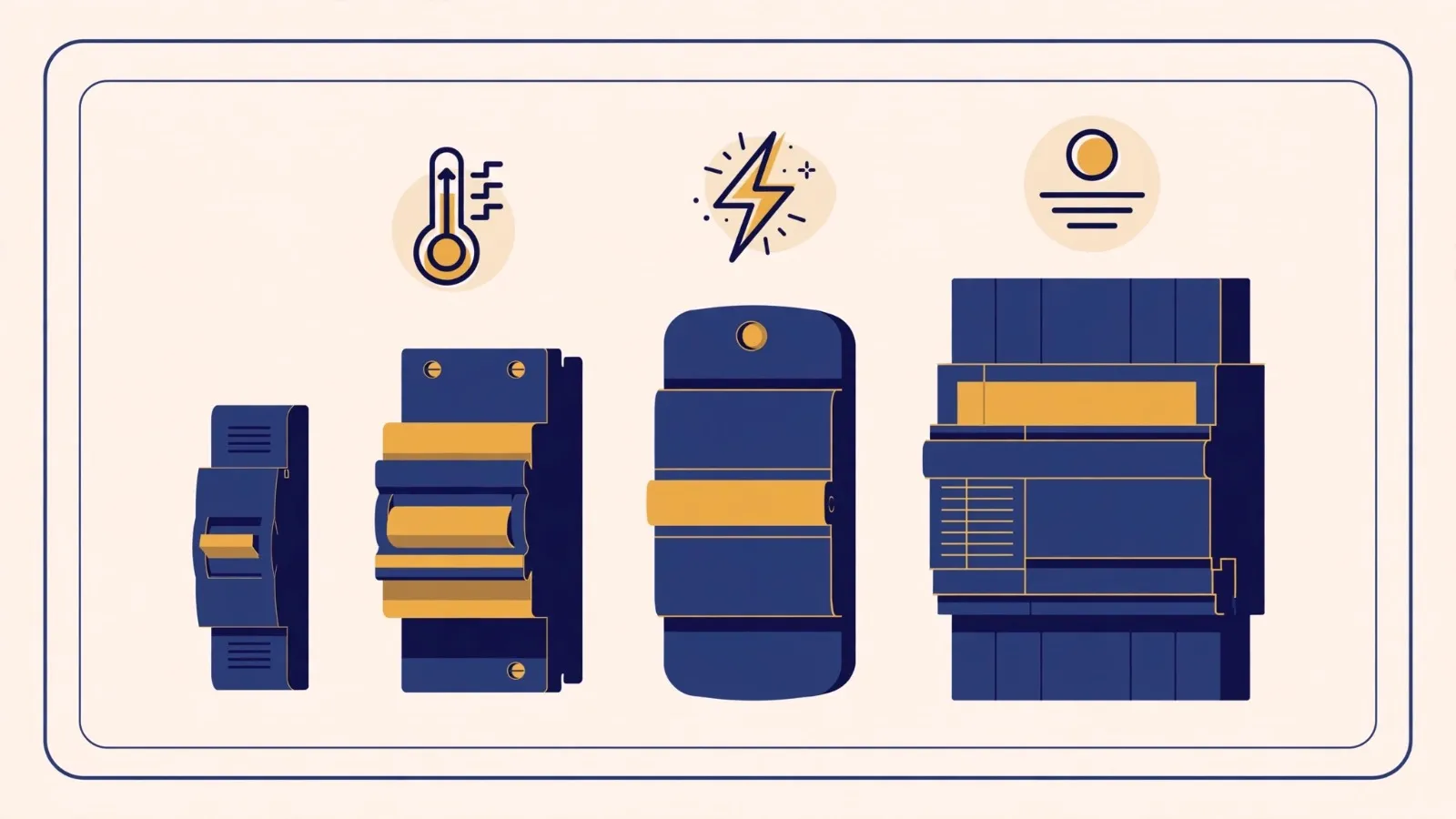
MCB, MCCB, ACB and RCCB are all circuit-protection devices, but they differ in current rating and what they protect against. In short: an MCB protects low-current final circuits, an MCCB handles higher currents with adjustable settings, an ACB protects the main incomer at very high currents, and an RCCB protects people from earth-leakage and shock. Most panels use several of them together.
Quick comparison
| Device | Full name | Typical current range | Trips on | Main use |
|---|---|---|---|---|
| MCB | Miniature Circuit Breaker | Up to ~125 A | Overload, short circuit | Final circuits, lighting, sockets |
| MCCB | Moulded Case Circuit Breaker | ~16 A to 1600 A | Overload, short circuit (adjustable) | Sub-distribution, larger loads |
| ACB | Air Circuit Breaker | ~630 A to 6300 A | Overload, short circuit (with relay) | Main LT incomer, high current |
| RCCB | Residual Current Circuit Breaker | Rated by sensitivity (30/100/300 mA) | Earth leakage | Shock and fire protection |
MCB — Miniature Circuit Breaker
The workhorse of final circuits. An MCB trips on overload and short circuit to protect wiring in lighting, socket and small-appliance circuits. Fixed trip characteristics (B, C and D curves) suit different load types — B for lighting, C for general and inductive loads, D for high inrush.
MCCB — Moulded Case Circuit Breaker
For higher currents than an MCB can handle, and often with adjustable trip settings. MCCBs protect sub-distribution boards, motors and larger loads, and their adjustability lets you tune protection to the circuit.
ACB — Air Circuit Breaker
Used at the top of an LT panel as the main incomer, handling very high currents. ACBs are usually draw-out type for easy maintenance and work with protection relays for precise, adjustable tripping. They’re the backbone of main distribution.
RCCB — Residual Current Circuit Breaker
Different job entirely: an RCCB detects an imbalance between live and neutral — the signature of current leaking to earth through a person or a fault — and trips fast to prevent shock and fire. It does not protect against overload or short circuit on its own, which is why it’s paired with an MCB. An RCBO combines RCCB and MCB functions in one device.
How they work together in a panel
A typical LT distribution scheme stacks them:
- ACB as the main incomer, handling the full current.
- MCCBs for sub-distribution to major loads and boards.
- MCBs on final circuits — lights, sockets, small equipment.
- RCCBs (or RCBOs) added for earth-leakage protection where people could be at risk.
Quick selection rules
- Protecting a small final circuit → MCB.
- Higher current or you need adjustable trip → MCCB.
- Main incomer at high current → ACB.
- Protecting people from shock → RCCB (or RCBO to combine with overload protection).
Frequently asked questions
What is the difference between an MCB and an MCCB?
Current rating and adjustability. MCBs cover low currents (up to ~125 A) with fixed trips; MCCBs handle much higher currents and often have adjustable settings.
When should I use an ACB instead of an MCCB?
Use an ACB for the main incomer at very high currents (roughly 630 A and above); MCCBs cover the range below that.
Is an RCCB the same as an MCB?
No. An MCB protects against overload and short circuit; an RCCB protects against earth leakage and shock. They do different jobs and are often used together.
What is an RCBO?
A single device that combines RCCB (earth-leakage) and MCB (overload and short-circuit) protection, saving space in the panel.
Get the right protection device on VendorStocks
From MCBs and RCCBs to MCCBs and ACBs, VendorStocks lets you browse across brands and ratings and request quotes in one place — new or surplus, with GST-compliant invoicing.
Browse circuit protection on VendorStocksDisclaimer
The content on this blog is for informational and educational purposes only. Product specifications, availability, and pricing mentioned in articles may not reflect current listings on VendorStocks. Always verify details directly on the product page before purchasing.